Published on November 4, 2026
US battery storage reached nearly 52 GW by mid-2026, and operators plan to bring another 26 GW online in 2027. Storage developers have always started from the grid, and that still holds. But a good connection no longer decides a project on its own.
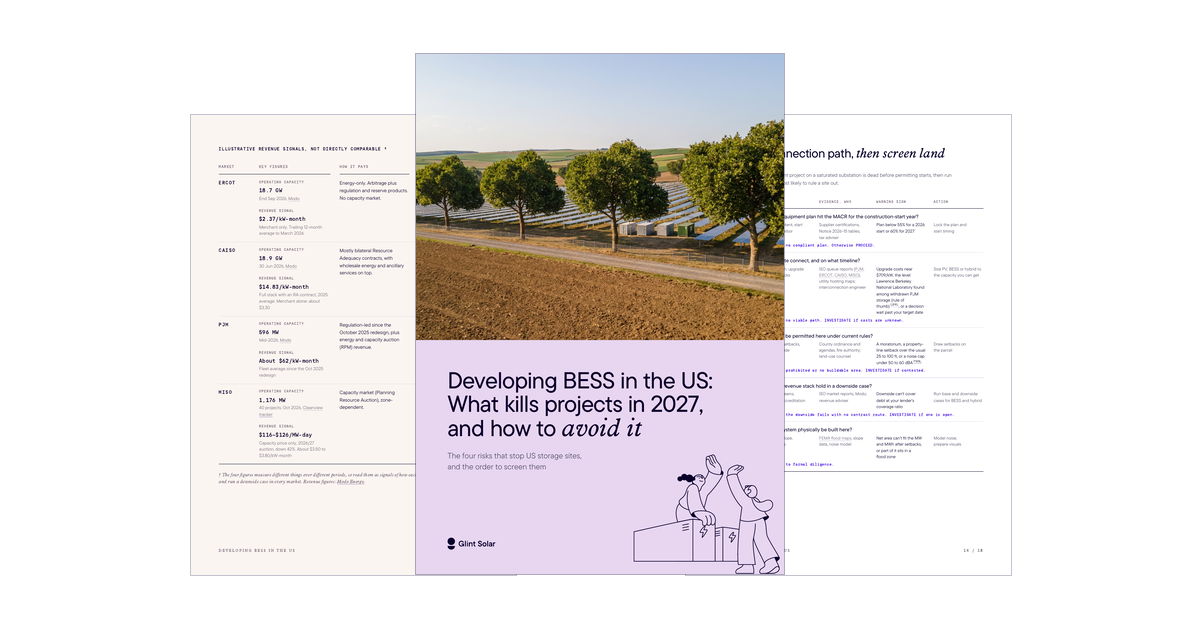
A site can clear the tax credit, hold a queue slot and pencil in its market, then stall at a county hearing. Our new guide takes the four risks that stop US storage sites one at a time, then sets out the order to screen a site in, so the money goes to the sites that survive.
Download the full guide here.
The sourcing test is stricter for storage than for solar
For projects starting construction in 2026 or later, a share of direct equipment costs has to come from outside a prohibited foreign entity. Miss that share and the project doesn't get a smaller tax credit. It gets none. Storage is held to a higher threshold than other technologies from day one, and it rises to 60% for anything starting construction in 2027. There's one timing lever that standalone storage still has and solar above 1.5 MW has lost, and the guide explains what it can and can't do.
The queue rewards readiness, and it still takes time
Battery storage was the largest category by project count in PJM's first reformed interconnection cycle: 349 projects and 66.5 GW. Relae puts the national average wait for an interconnection decision at 25 months, with 20 in ERCOT and 40 in PJM, and longer where data-center load is concentrated. Faster routes exist for projects that qualify. PJM expects one of them to reach an interconnection agreement about 10 months after filing.
Each market pays a battery differently
ERCOT is energy-only. CAISO leans on Resource Adequacy contracts, PJM pays a regulation premium that Modo Energy expects to fall as more storage arrives, and MISO's capacity price dropped 42% in the 2026/27 auction. A case that rests on today's premium can fail once it's gone. The guide sets the four markets side by side, with what rules a project out in each and the downside case to run.
Permitting is where projects stall late
The 2026 edition of NFPA 855 tightened the fire code, and the response to the Moss Landing fire in January 2025 played out at state and county level. California, Texas and Michigan have each taken a different route since. In Michigan, storage projects of 50 MW and 200 MWh or more can route permitting to the state when local rules are stricter than its standard. That route is open today, but 79 townships and counties have asked the state Supreme Court to hear an appeal.
Start at the substation
A compliant project on a saturated substation is dead before permitting starts, so the guide's screening order begins with the connection. It then runs one hypothetical 100 MW / 400 MWh site through all five stages, and shows where the site lost a fifth of its capacity and why it still moved forward.
Download the guide
Developing BESS in the US: What kills projects in 2027, and how to avoid it covers standalone, utility-scale storage in ERCOT, CAISO, PJM and MISO. It ends with a one-page checklist and five dates between December 2026 and the end of 2027 that change how hard each risk is to clear. Download it for free.
Download here.