Two parcels, one permit: what actually decides a German BESS site
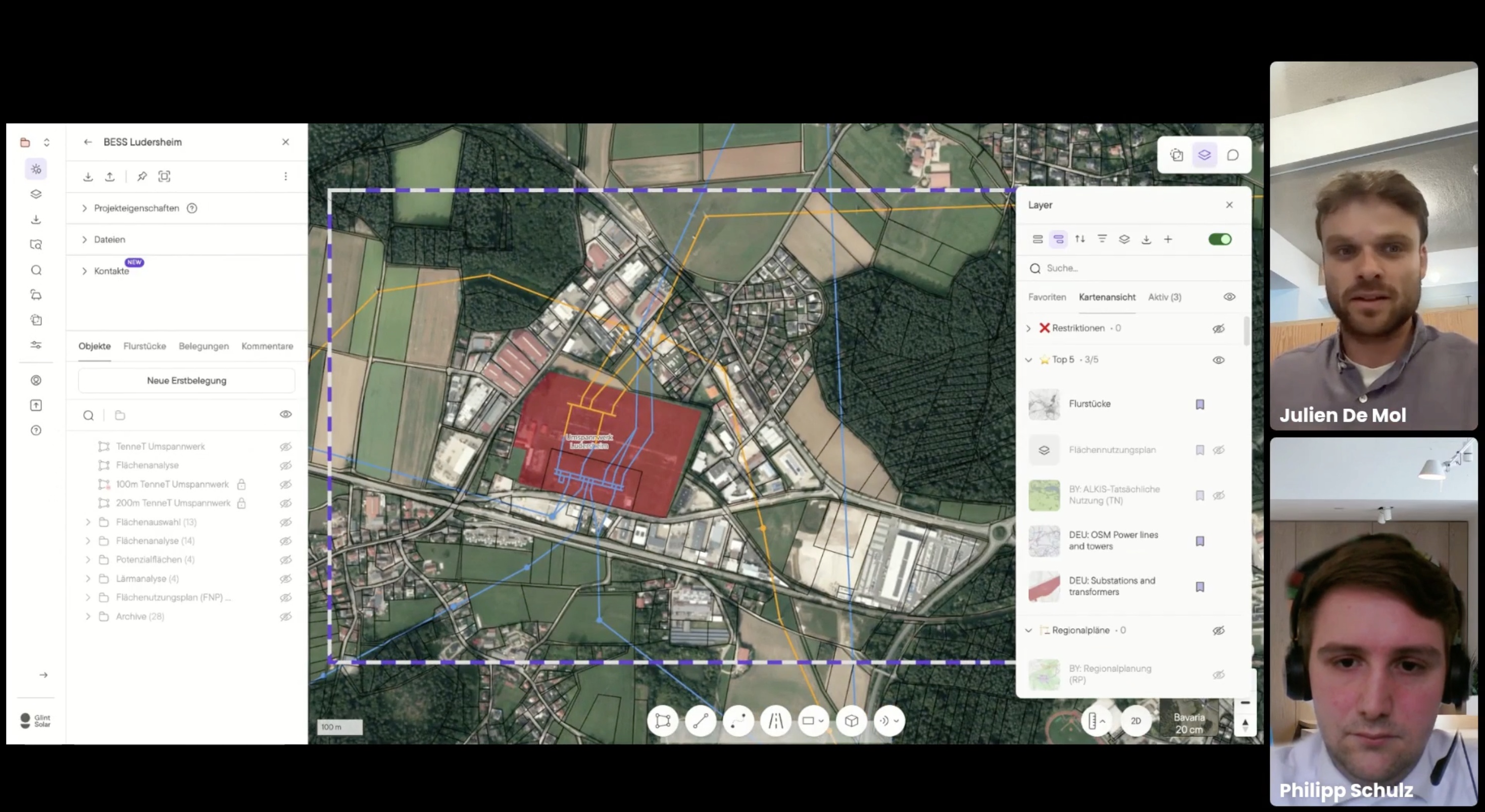
Julien De Mol screened the land around one TenneT substation in Bavaria and came out with two parcels worth keeping. Then the noise forecast took one of them back.
The short version
Two tests decide whether a battery site is worth a grid connection application at all. Whether it counts as privileged under §35 BauGB, which in practice means sitting within 200 metres of a substation. And whether it holds the TA Lärm noise limits at the nearest dwelling.
A parcel can pass the first and fail the second. That is exactly what happened here, and you only see it by running both against the same layout.
Philipp Schulz, Project Manager for PV and BESS at Recurrent Energy, leads permitting for their battery pipeline and took the regulatory half. Julien De Mol of Glint Solar screened a real substation against it, twice. Their on-demand session was recorded on 4 June 2026, in German.
A queue that outgrew the grid
50Hertz called it the BESS tsunami. In the BDEW interim report, the transmission operators and the 17 largest distribution operators, together about half of Germany's grid area, had accumulated over 720 GW of connection requests. Around 78 GW of that was already reserved.
720 GW
connection requests
TSOs plus the 17 largest distribution operators. 78 GW of it reserved.
263 GW
installed generating capacity
Germany's entire generating fleet, for comparison.
~100 GWh
storage needed by 2030
Fraunhofer's estimate of what the system actually requires.
What the queue measures is not demand, it is how cheap an option was to hold. A request to a distribution operator cost little, and in 2024 you did not need land control to make one. So the same megawatts piled up several times over, until first come, first served collapsed under the weight.
What replaced it is a scored procedure. Once a year the transmission operators publish a map of substations with free capacity, and applicants collect maturity points for land control, a technical concept and financial standing. You are no longer racing the clock, you are competing against everyone else at the same connection point.
from 1 Apr 2026
Phase A, information and application
Public information on connection options, an optional technical pre-check, then application through the grid portal.
Nothing yet.
by 30 Jun 2026
Phase B, maturity and cluster assessment
Admissibility check, maturity scoring, grid compatibility check, capacity allocation.
A €50,000 application fee.
by 30 Nov 2026
Phase C, offer phase
The grid operator issues an offer. You accept by lodging the realisation deposit.
€1,500 per MW, creditable against the connection-cost contribution.
Dec 2026 to Jan 2027
Phase D, pre-project phase
Technical coordination on the connection concept and the next planning steps.
Instalments of the connection-cost contribution, plus connection costs.
The order is worth a second look. The €50,000 falls due at submission, months before anyone has checked whether the site can be permitted.
"There is nothing more annoying than paying a 50,000 euro application fee, getting your grid capacity, and later realising it cannot be permitted."
Philipp Schulz, Project Manager PV and BESS, Recurrent Energy
The 30 June date has since passed. Live now are the offer phase and the acceptance window, and behind them runs a second clock: the AgNeS determination on grid fees is expected in early 2027, and the twenty-year grandfathering reaches only projects whose final investment decision was taken before it takes effect.
What privileging requires, and what stays open
A standalone battery is privileged in the Außenbereich if it exceeds 4 MW and sits within 200 metres of a substation, or of a power plant of 50 MW or more. Co-located batteries take their own route, at least 1 MWh alongside an existing wind or solar plant, where even "existing" is open to interpretation. The 4 MW is no obstacle for most. The 200 metres is where it is decided.
Because there are two readings, and they produce very different maps. The inclusive one requires every component of the plant to sit inside the radius. The looser one lets a sliver of the parcel privilege the whole parcel.
From the recording, 17:46
Philipp Schulz on the two readings of the 200 metre rule, and the state that has already told its building authorities which one applies. Watch the full session
No case law settles it. Philipp reads the wording against the conservative interpretation; Baden-Württemberg has instructed its building authorities to apply exactly that. Practically it means talking to the municipality and the building authority early, and keeping at it, because the answer is being set at state and district level while projects are already running.
Above that sits a cumulative cap of 0.5 percent of the municipality's area, up to 5 hectares. Only approved building applications count against it, so everything in flight is invisible. First come, first served did not disappear, it moved to the building authority. At least the proposed 100 metre no-build ring around substations fell out of the cabinet bill.
"So we do not have to plan our projects in donut form."
Philipp Schulz on the dropped buffer zone
What was added is a second route: municipalities will be able to designate special areas in their preparatory land-use plan, carrying the same standing as the 200 metre radius. That opens a second race, between the developers already inside the radius and the municipality drawing a plan that reaches beyond it.
One substation in Bavaria, screened
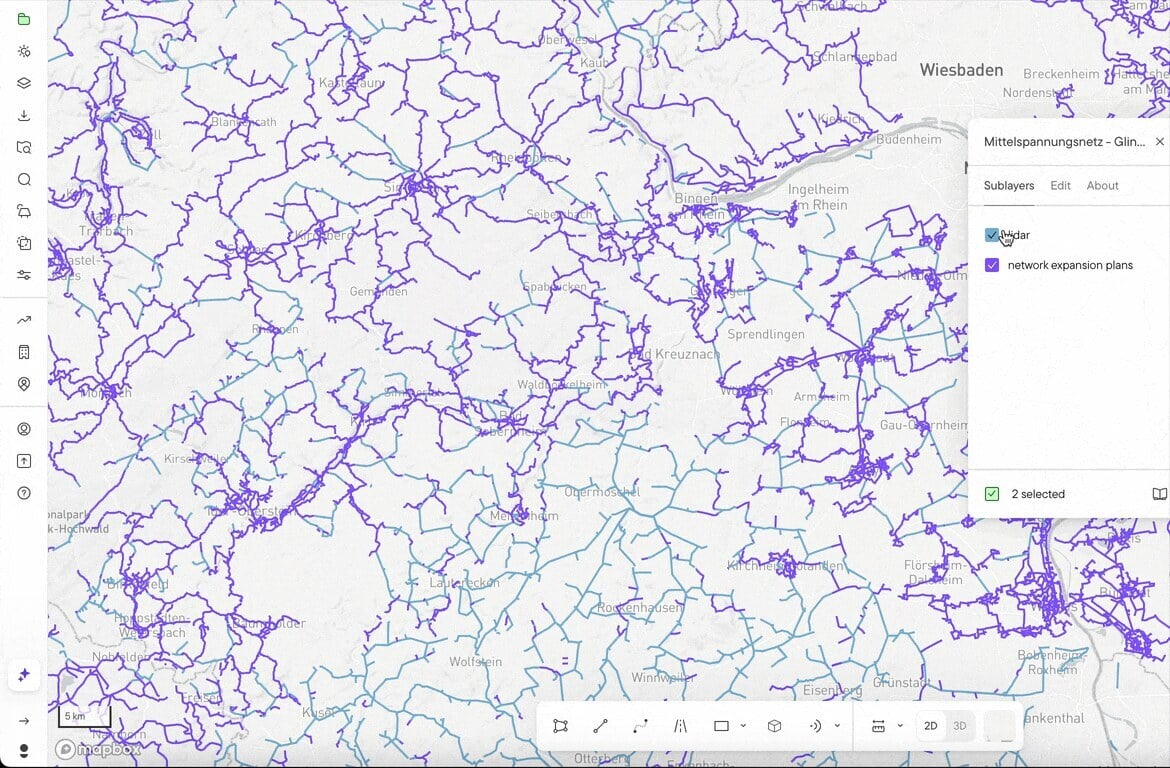
The demo starts where the rule does. Cadastral parcels, grid lines and substations are already built into Glint Solar as data layers, so screening begins with the data on screen. Before drawing anything, Julien checks every layer for what intersects the area: a biotope mapping, a protected landscape area, a bird protection area, a water protection area. None of it is surprising on its own. The point is not finding it three months later.
For the 200 metre buffer he takes the quietly most useful of three routes: upload the municipality's land-use plan as a georeferenced PDF, trace the substation boundary with the polygon tool, and buffer out from there. The privileging zone becomes a shape you can test parcels against.
From the recording, 30:59
The area analysis in Glint Solar runs a restriction profile across the whole zone and returns what is left. Watch the full session
A restriction profile is a saved list of what has to be true: parcels of at least 0.6 hectares and no more than 5, nothing on residential, commercial, industrial or moor land, no buildings, no protected areas. Roughly 80 percent of the area falls out on land use alone.
Then the manual pass, and here the space disappears. A 50 metre buffer to nearby buildings takes half the first candidate, a 30 metre buffer to the forest edge for fire and insurance takes more, and a 110 kV overhead line crosses the rest. For a plant that has to exceed 4 MW, nothing is left. Two parcels survive, both on the western flank.
Why noise rules out more sites than people expect
Batteries are not quiet, and the datasheets understate them in the same way every time.
From the recording, 40:57
Philipp Schulz on why the number in the datasheet is not the number to simulate with. Watch the full session
A 20-foot container at today's power density averages around 90 dB(A) of sound power. Manufacturers usually quote the level measured at one metre, which is roughly 70. Simulate from 90. The levels then sum logarithmically, doubling identical sources adds 3 dB, and on Philipp's worked example of 519 MW across 66 modules the combined sound power reaches 110 dB(A).
What that has to clear is the TA Lärm, an administrative regulation rather than a statute and binding on developers in practice. The night values are the constraint, and the assessment always assumes the worst case: full load at night.
TA Lärm guide values at night (22:00 to 06:00)
Dot = guide value per area type. Dashed = measured level without a noise barrier (65 dB(A)). Solid = with a 6 metre barrier (45 dB(A)).
Two things make those numbers harder than they look. Where noise load already exists, authorities frequently require the new contribution to sit at least 6 dB(A) below the guide value. And inverters with tonal components attract a level surcharge of 3 to 6 dB in the acoustic report.
The area types come from the Bebauungsplan, and in the Außenbereich there usually isn't one. The land-use plan gives an orientation, and failing that every building on the satellite image has to be taken seriously: in case of doubt the stricter category applies, and a single dwelling is assessed as general residential, 55 by day and 40 at night.
Mitigations exist and mostly cost money. Silencer kits and better fans, water cooling claiming up to 20 dB, turning the fan side away from dwellings, encapsulating transformers and PCS units, and finally barriers. Six metres works acoustically and is a visible intrusion that becomes somebody else's objection. Failing that, restrict night-time operating modes and price in the lost revenue.
The parcel that clears privileging and fails on noise
On privileging the southern parcel was clearly the better candidate: almost entirely inside the 200 metre zone, so it holds under either reading. Only a corner of the northern one is inside. Then the noise forecast, run four times, with the transformer station at 85 dB, container values from the datasheet and 35 dB of background noise.
From the recording, 51:43
The northern parcel in Glint Solar, before and after a 6 metre barrier. From over 65 dB at the commercial area down to 45. Watch the full session
Without a barrier the northern parcel is over 65 dB at the commercial area, with one it is 45. That clears commercial and mixed, and leaves the residential area slightly over, close enough for setbacks to finish the job. The southern parcel exceeds everywhere without a barrier, and with a 6 metre wall it only just reaches under 50 dB at the commercial area while mixed and residential stay clearly over. On noise it is not permittable.
So the parcel that looked strongest on privileging is the one that goes, and the marginal one is where the money is worth spending.
"Noise is now an absolutely critical factor in BESS project development."
Julien De Mol, Account Executive, Glint Solar
Two caveats Philipp was firm about. The layout in the demo is idealised, and barriers belong as close to the source as possible rather than ringing the site like a fence. And a screening forecast is not an acoustic report: it is built on the CNOSSOS model, runs within about 3 dB of a certified assessment, is not ISO certified, and has to be signed off by an acoustic consultant.
"This does not replace an acoustic report. But it does tell you where a report would be a waste of money."
Philipp Schulz
What to check before you pay the fee
The German specifics travel less well than the sequence does. The cheap tests belong before the expensive ones: privileging status and a first noise estimate cost an afternoon between them, while the application fee, the deposit and the acoustic report cost real money. Both constraints belong screened at once rather than in sequence, because a site optimised against one gate fails the other. And the layout belongs in early, because noise is a function of geometry: where the containers sit, which way the fans face, whether a wall stands at the fence or behind the rack all change the answer.
That is what Glint Solar is built for. German cadastral parcels, grid lines and substations are in the map already, with 350+ data layers for Germany, so the privileging zone is drawn rather than assembled. Restriction profiles apply your criteria across a whole area at once. Layout, exclusion zones and setbacks live in the same project as the noise forecast, so changing the geometry re-runs the constraint. And PV and battery sit in one project rather than two. No AutoCAD, no desktop install, browser-only.
For the regulatory detail in writing, seven things developers need to know about Germany's new BESS rules covers the same ground in more depth, and there is a longer guide co-developed with Philipp. On noise, what developers need to know about BESS noise emissions is the companion piece.
BESS in Deutschland 2026
The full session with Philipp Schulz of Recurrent Energy and Julien De Mol of Glint Solar: the market context behind the rule changes, privileging under §35 BauGB in detail, the TA Lärm limits that decide permittability, and two live screenings of a real substation. Recorded 4 June 2026, in German.
Watch on demandWant the same two tests run on a substation you are already looking at? Book a demo and we will go through it with you.