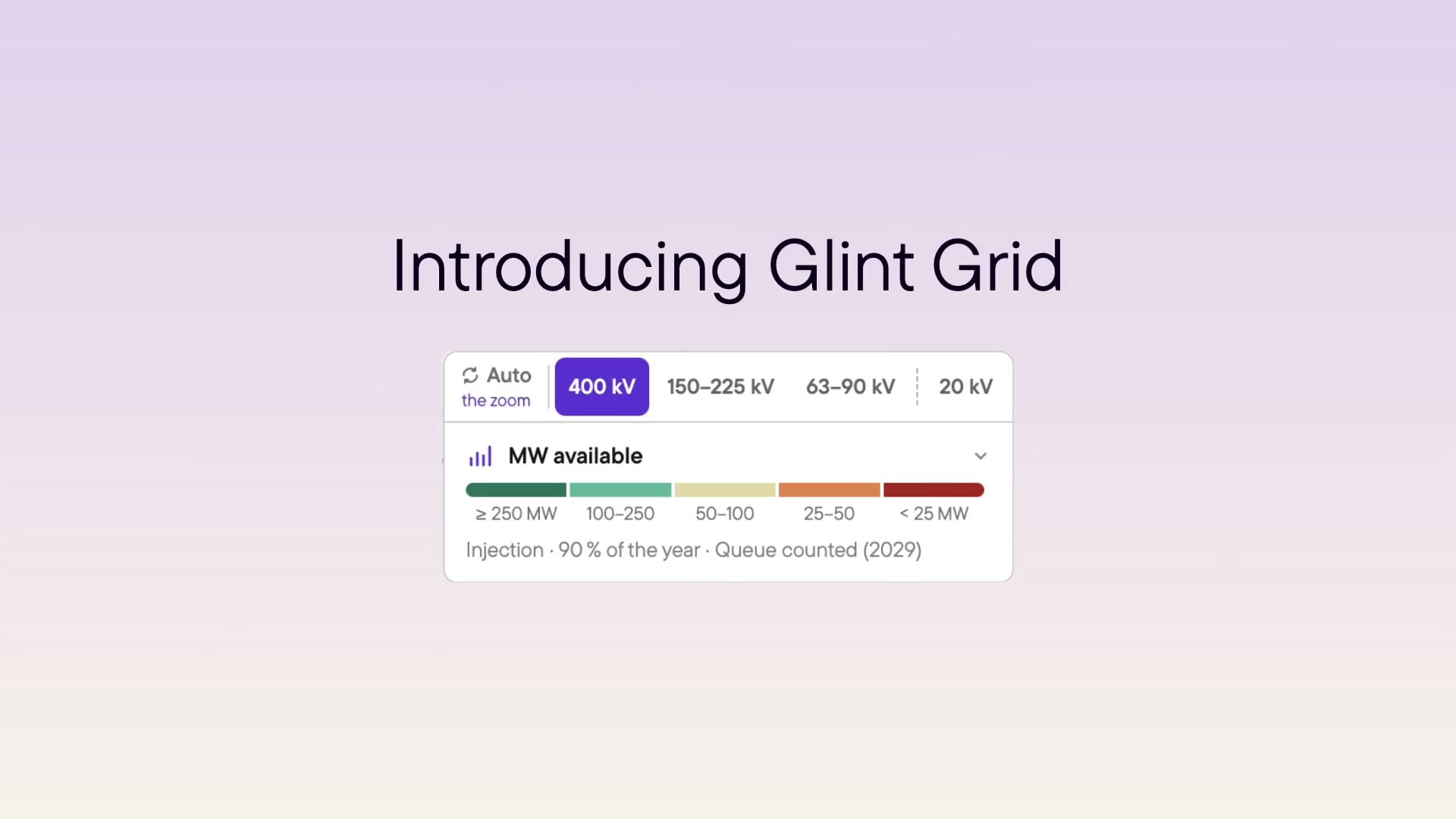
We speak to developers all the time, and several have told us that their approach is to pick locations that have multiple options to connect, and hope for the best. The maps and tools provided by RTE and Enedis give you an indication, but they don't let you explore what the situation might be a year from now, given the planned extensions and other projects in the queue. Glint Grid aims to solve this problem.
Glint Grid
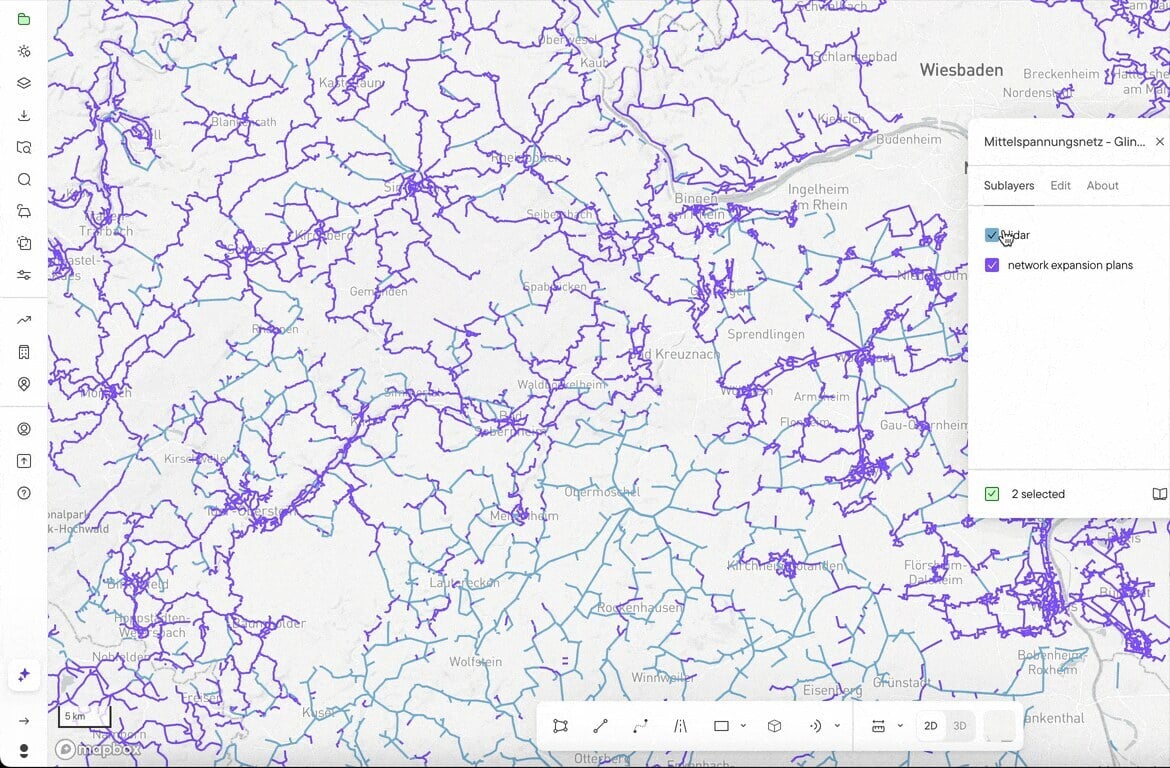
On October 1 we launched the pilot program for our new product, Glint Grid. With Glint Grid you can run a custom capacity study that takes into account your project and the grid upgrades you choose to include. We support both the medium and high voltage grid networks, HTA and HTB. We also give you a single point of entry for the relevant information about the grid, including future upgrades, competing projects and how far along they are. A project whose environmental study has been approved is further along than one that has just applied, and one with no paper trail for three years may have been abandoned.
So what is this based on?
Relative to most countries, France has good public data about the grid, production and consumption. In a collaboration between our in-house grid experts and the Institute for Energy Technology (IFE), we have been able to use this data to build a model of the French HTA and HTB networks. This model takes into account the electrical properties of the various components and how the grid is operated. We simulate the consumption and production along the grid. For HTA we use the same planning scenarios as Enedis. Since we model the grid and get the capacity that way, rather than relying on some external data for the capacity, we get the flexibility to run studies with different input parameters, such as changing the project size or evaluating future grid upgrades.
Of course, this model relies only on public data, and even with good public data, we still have to make assumptions and build heuristics for many missing pieces of the puzzle. Where are the switches, and which are open or closed? We know the production in an area, but exactly where on the line does it connect? The same goes for consumption. We know the planning scenarios for HTA, but we don’t know them for HTB. All in all, this leaves room for error. We think the best approach is to show the model limitations, so that you can make educated decisions about how much to trust it. In the tool we show sanity checks for each substation, so you can get a sense of how reliable the model is at that particular substation.
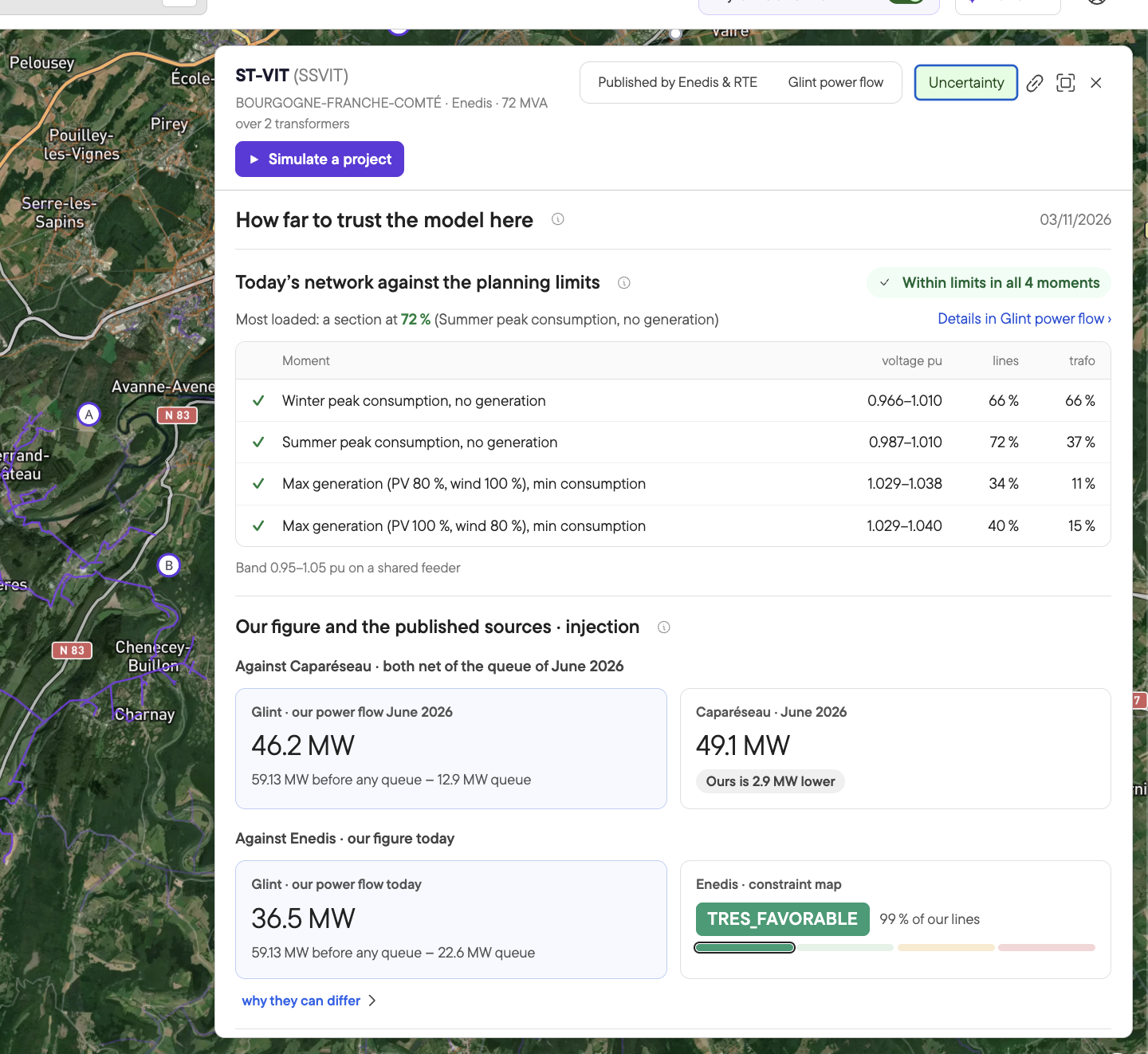
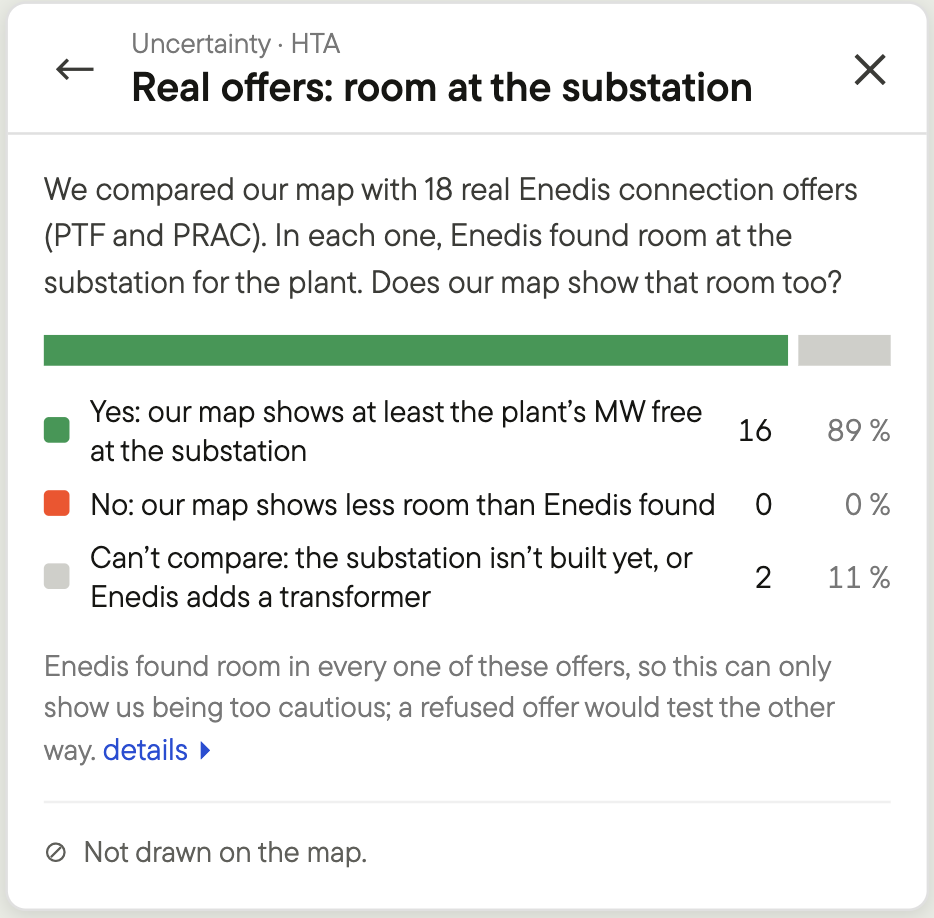
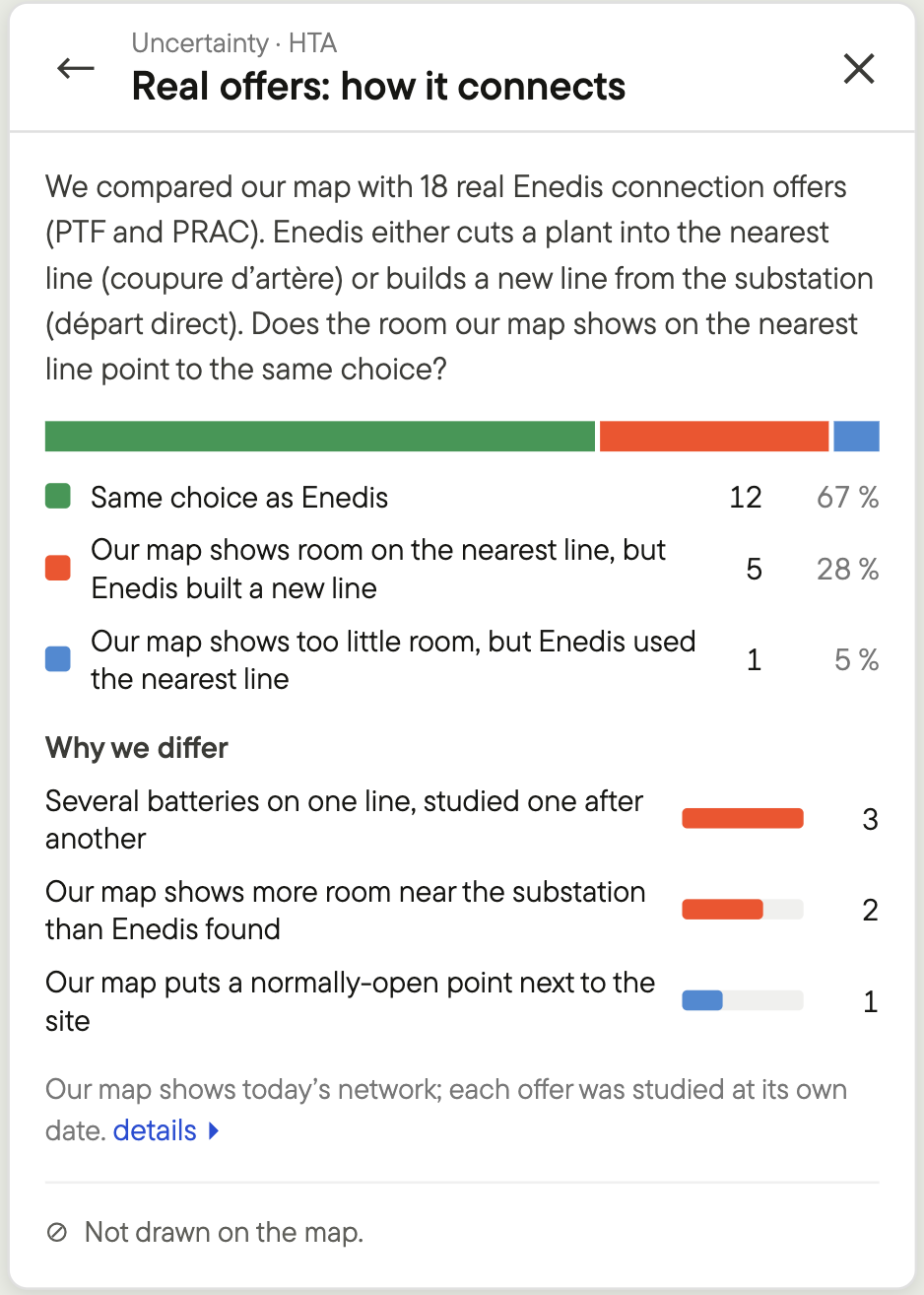
A model is best evaluated based on real-world cases. Working with our pilot clients, we compared our results against the responses provided by Enedis for 18 projects that had recently received a grid connection offer (PTF or PRAC). Regarding the first question a developer typically asks, whether there is available capacity at the primary substation, our model reached the same conclusion as Enedis in 16 out of 18 cases. The two discrepancies are because Enedis proposed the creation of a new primary substation or the installation of a new transformer, solutions that our model does not offer. As for the connection solution itself, our model’s findings aligned with those of Enedis in 12 out of 18 cases.
The HTB model is newer. It passes our internal checks but has not yet been compared with RTE offers, so treat its results with more caution.
This is the state as of 10 November. As we keep working and get more data and feedback from our pilot customers, we continue to improve.
Second cohort now open
We kept the first cohort very limited, and had to say no to some, because we wanted time for close collaboration with the participants. We are now opening a second cohort. If this sounds interesting and you have PTFs you can share, we would like to hear from you. Contact your Customer Success representative or sign up here.