Webinar Recap: BESS in Germany 2026 - What To Get Right Before 30th June
Published on June 4, 2026
In a recent webinar, Glint Solar's Julienne and Philipp Schulz, Project Manager for PV and BESS at Recurrant Energy, hosted a session on the German market, walking development teams through the two issues deciding which grid-scale battery projects actually get permitted: privileging in outdoor areas, and noise protection. Each topic was followed by a live walkthrough in Glint Solar.
What you’ll take away
-
How Germany's privileging rules under §35 BauGB and the maturity procedure are shaping which sites are realistically worth pursuing
-
Where the 200-metre privileging radius and the 0.5 percent, 5-hectare cap actually leave room to build
-
Why noise is now a critical, often underestimated constraint for battery storage, and how to screen for it before you commit
-
How early layout and noise screening de-risk your pipeline before you pay grid connection fees
What was covered
Most development teams in Germany were facing the same picture. A flood of connection requests, regulatory rules that kept changing month to month, and uncertainty over which parcels would qualify. The result was capital and connection fees committed to land that didn't hold up, and pre-development work that had to be redone once the constraints became clear.
The session walked through how to screen that early phase with confidence, covering:
-
The market context behind the surge in legal changes, from the connection-request flood to the shift away from first-come-first-served toward the maturity procedure
-
What the latest privileging rules mean for which parcels qualify, including the open questions around the 200-metre radius and the cumulative cap
-
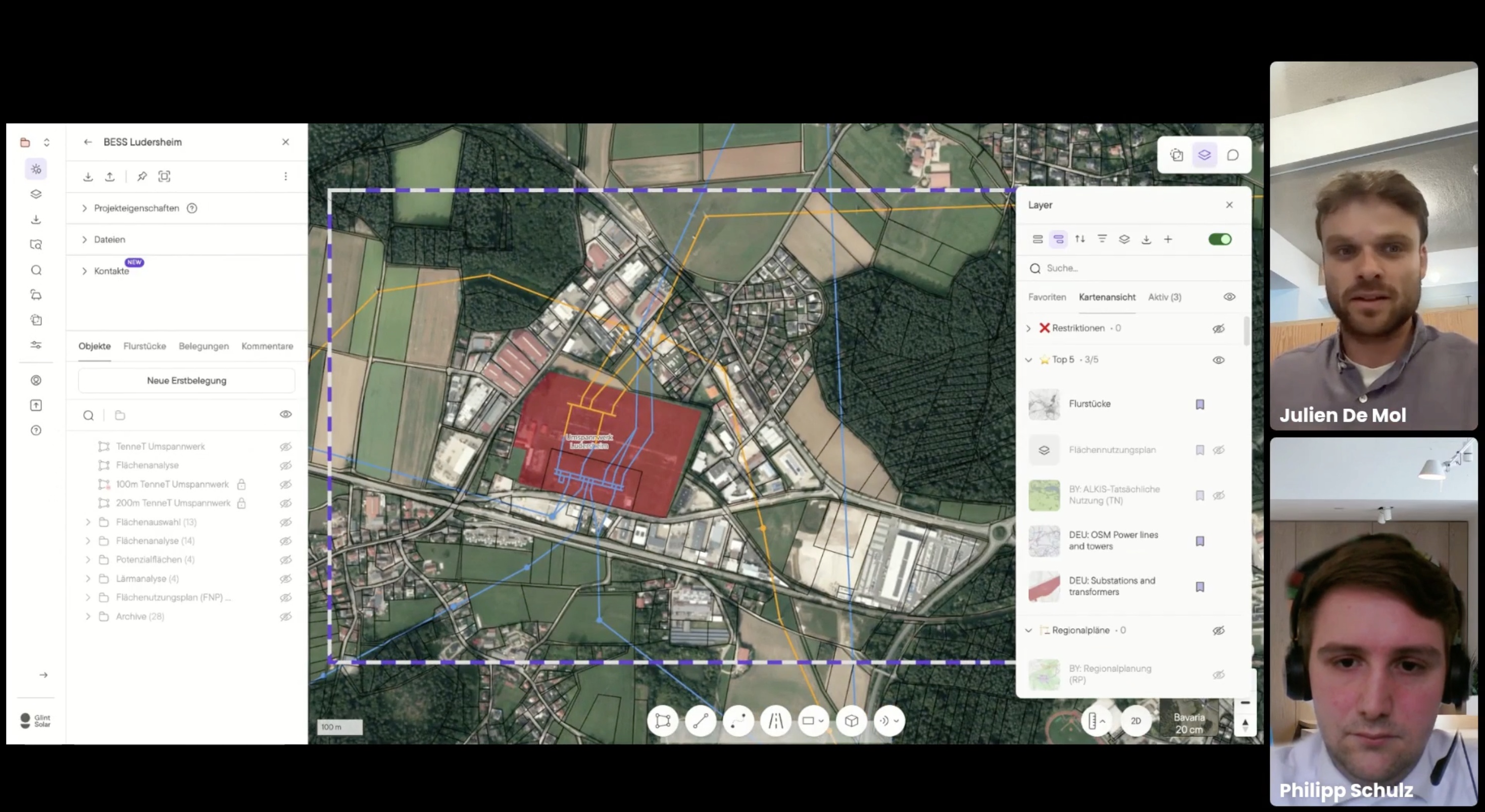
A live walkthrough of finding parcels inside the privileging radius around a real substation, then filtering to the strongest candidates
-
Why noise limits under the TA Lärm matter for battery storage, and a live noise-emission forecast run with and without noise barriers to see which sites stay permittable
Why this matters
In Germany, the upstream decisions are what shape everything downstream. By the time a project reaches a grid connection submission or a noise assessment, the budget and the risk have already been set in pre-development. Paying a connection fee on a site that can't clear privileging or noise is an expensive way to find out it never qualified. Teams that screen those early phases move faster, with more confidence and less rework. As pipelines grow and the rules tighten, the quality of pre-development decisions becomes a competitive advantage.
Who should watch
-
Solar and BESS developers active in the German market.
-
Development teams managing grid-scale battery and hybrid portfolios.
-
Leaders responsible for grid connection strategy, permitting, or site qualification.
-
Anyone preparing submissions for the maturity procedure and screening for privileging and noise risk before they commit.
Webinar is in German