Published on April 23, 2026
PV-BESS Hybrid Analysis, now live in Glint Solar, gives development teams a way to answer that question early. Model combined PV and BESS performance, compare dispatch scenarios, and project lifetime revenue directly inside the platform, before committing to detailed engineering.
The shift has been fast. Hybrid solar-plus-storage deployments grew 47% year on year, and six European markets each logged more than 500 hours of negative electricity prices in 2025. Grid congestion and curtailment risk are pushing developers toward storage as a financial necessity, not an optional add-on.
The modeling gap that slows hybrid projects down
Adding a battery to a solar project changes how energy flows through the site. Production, revenue, and grid interaction all depend on how the battery charges and discharges, and that depends on the dispatch strategy, the grid limit, the market price curve, and the sizing of both the PV and the storage system.
Most teams handle this with custom spreadsheets, outsourced consultants, or multiple tools in parallel. The result is slow, expensive, and hard to iterate on. Comparing three sizing options across two dispatch strategies can take days, and when the numbers come back they're often disconnected from the site design that generated them.
For teams evaluating dozens of hybrid sites, this creates a bottleneck at exactly the wrong stage. Projects that should take hours to screen take weeks. Sizing decisions that should be tested and compared get locked in too early because iteration is too costly.
Why this matters now
The economics of standalone solar are under pressure. Curtailment rates are rising across congested grids. Capture rates are falling as more solar comes online at the same hours. Storage is increasingly what makes a solar business case bankable.
Investor expectations have moved with the market. On many hybrid projects, even where IRR would be higher without storage, investors increasingly want to see BESS on site as a form of diversification and risk protection. That makes sizing the critical question for hybrid projects: what capacity to add, and how it changes the financial case.
The window to move on the best hybrid sites is narrow. Grid connection queues are growing. In Germany alone, over 720 GW of BESS connection requests have been filed. Developers who can demonstrate efficient grid utilization through hybridization are better positioned to secure connections. Those still waiting on consultants and spreadsheets will be late.
Introducing PV-BESS Hybrid Analysis
PV-BESS Hybrid Analysis runs on the same site design your team is already working with in Glint Solar. Batteries charge from the grid and/or from curtailed PV, with revenue maximised using historical spot prices. Set a grid limit, configure dispatch rules, and run the analysis. The platform uses linear programming to simulate how the combined PV and BESS system operates across a full year of market conditions, then projects results over the plant's operational lifetime.
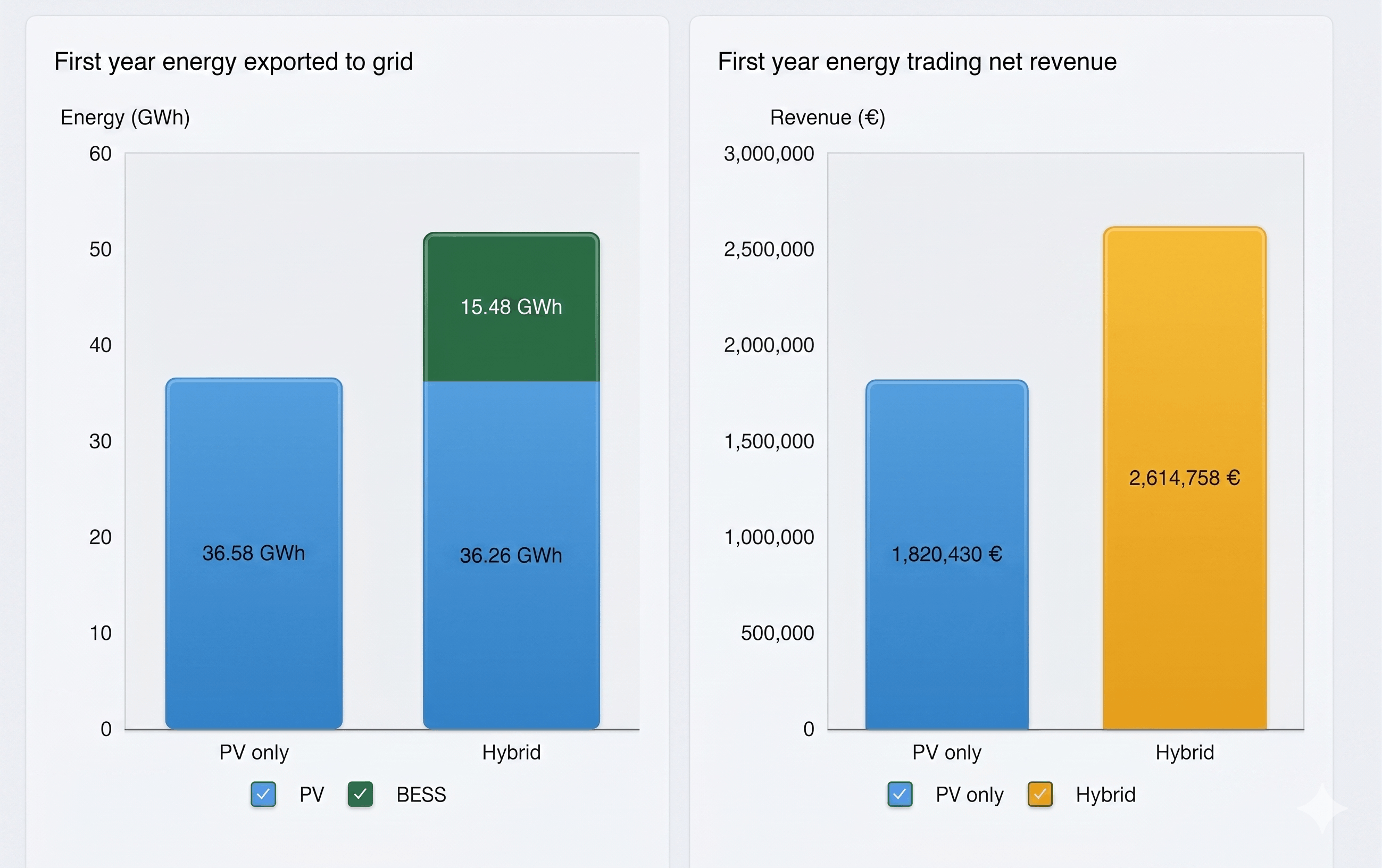
The result is a full hybrid optimization with arbitrage, giving development teams a complete view of net revenue over the project's lifetime.
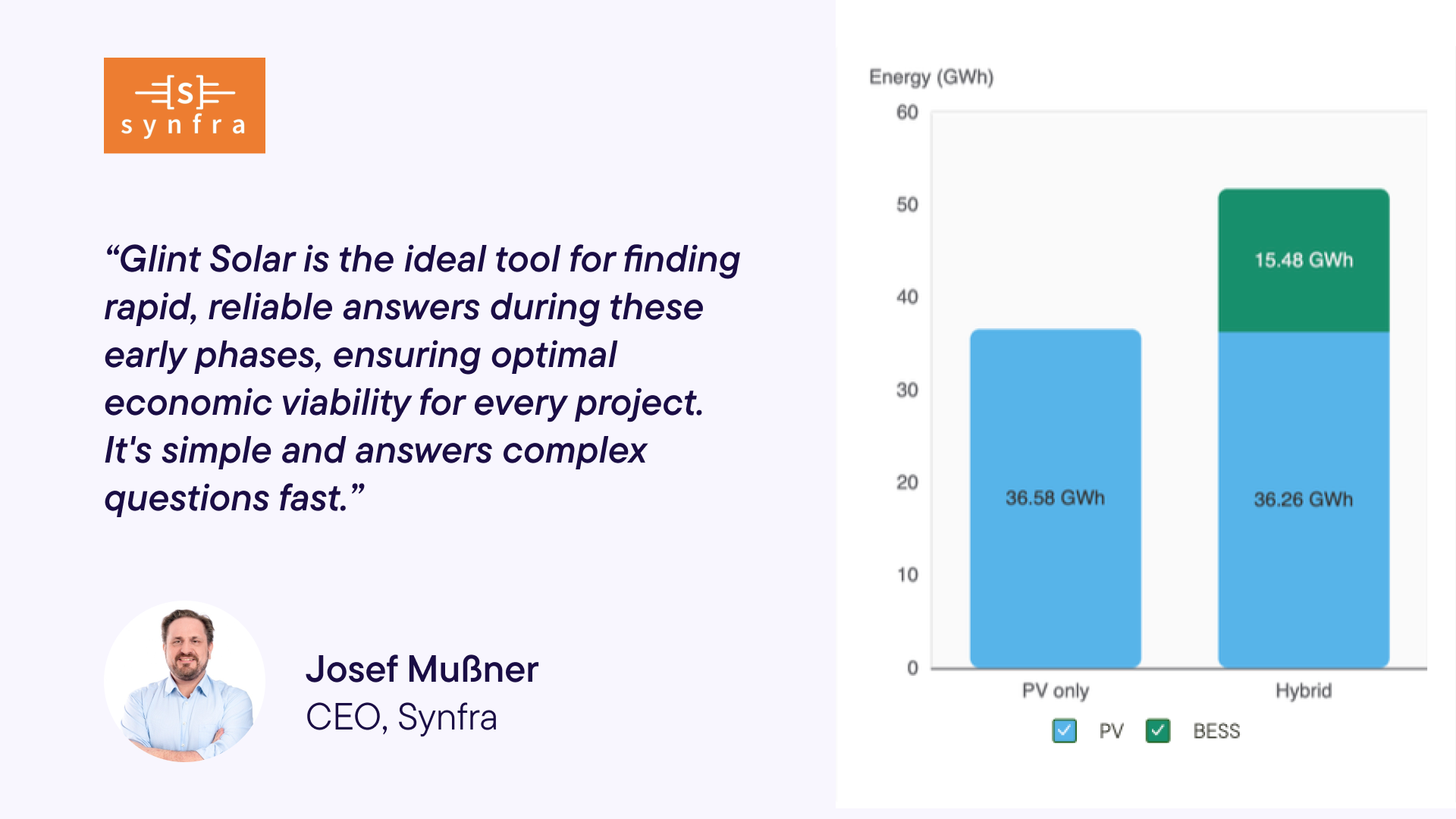
"Even in the early stages of project development, today's developers must address technical design questions, specifically the critical ratio between PV output, BESS power, and BESS capacity. In an era of scarce grid connection capacity, these are the decisions that define a project's future. Glint Solar is the ideal tool for finding rapid, reliable answers during these early phases, ensuring optimal economic viability for every project. It's simple and fast answers to complex questions." - Josef Mußner, CEO of Synfra
With PV-BESS Hybrid Analysis, development teams can:
-
Model four dispatching strategies to match their project's commercial model: full hybrid optimization with arbitrage and green energy storage with price signals.
-
Compare sizing options side by side using built-in indicators for cycles per day, depth of discharge, and grid utilization, so oversized or undersized configurations are visible immediately
-
Estimate revenue over the project lifetime using historical spot prices and linear programming to reflect real market conditions
-
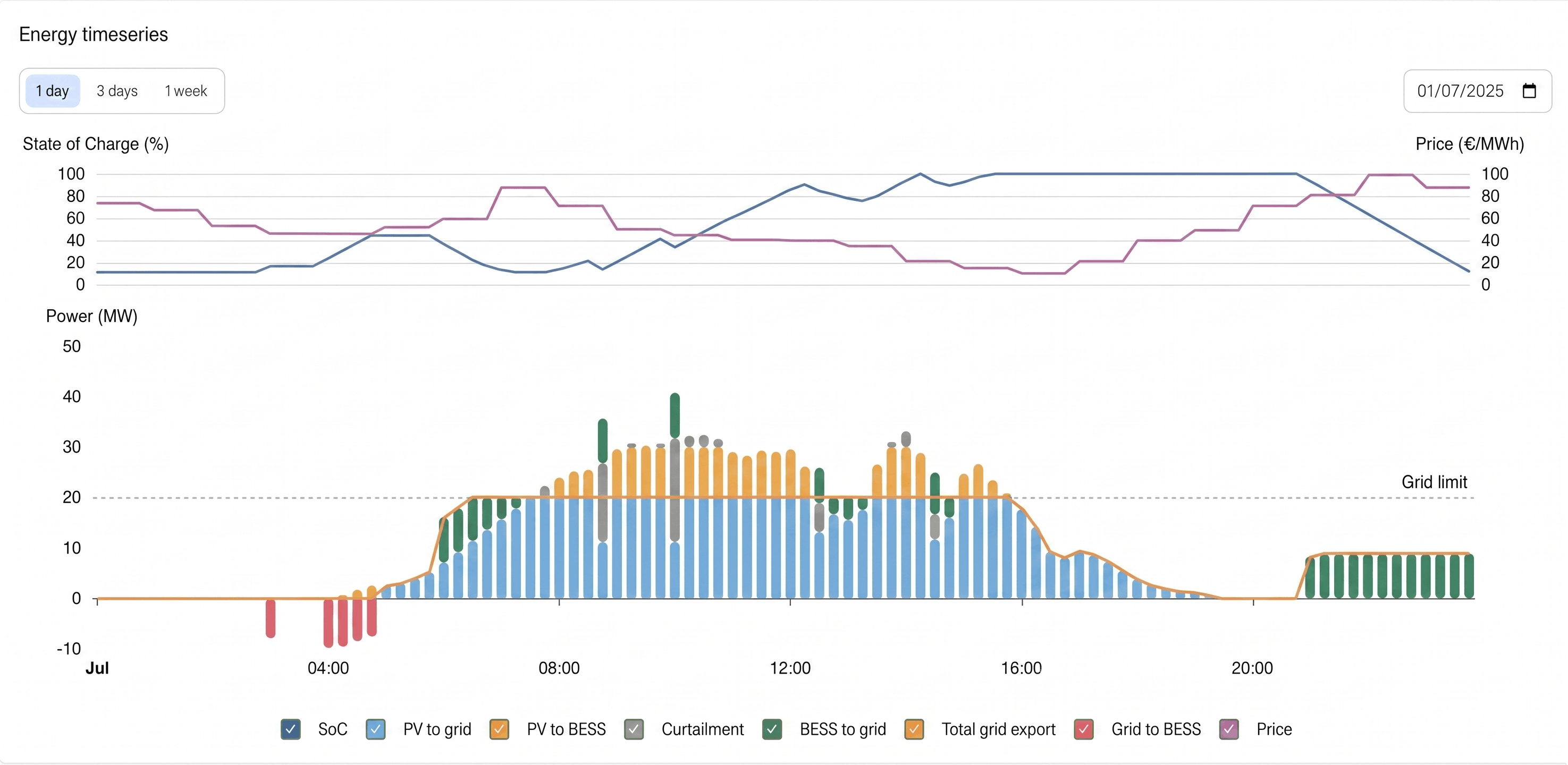
Visualize energy flows through interactive time series graphs showing PV-to-grid, PV-to-BESS, BESS-to-grid, state of charge, and electricity prices
-
Iterate in minutes, not days by adjusting battery capacity, grid limits, or strategy and re-running the analysis without leaving Glint Solar
Who this is for?
PV-BESS Hybrid Analysis is built for development teams who are adding storage to their solar pipeline and need a faster way to compare sizing options and understand revenue potential before committing engineering resources.
If your team is evaluating multiple sites for hybrid potential, comparing battery sizing options, or trying to build an internal view of revenue before engaging consultants, this is designed to give you that first confident answer. It's especially relevant for teams operating across France, Germany, Italy, and Poland, where price-based arbitrage modelling is fully supported with local market data.
One thing worth noting: this is a preliminary modelling tool. It's designed to help development teams compare sizing configurations and estimate revenue potential early, before committing to detailed engineering or consultant-led feasibility studies. It isn't a replacement for full financial modelling or bankable assessments. What it does is give you the energy and revenue data you need to make informed sizing decisions and filter your pipeline with confidence.
See it in action
If you're exploring hybrid for your pipeline and want to see PV-BESS Hybrid Analysis in action, make sure to book a demo!