Published on June 4, 2026
Glint Solar has always been the place where the first part of that, finding the site and laying out the design, gets done. The rest has had to live somewhere else.
That's the gap we're closing today.
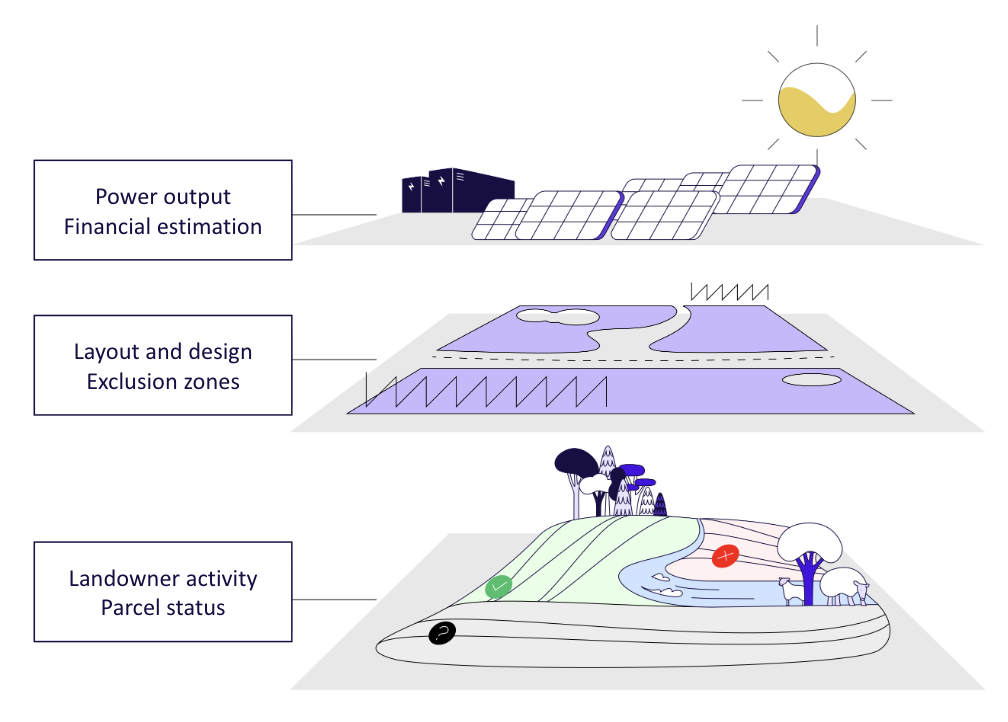
For most development teams, "somewhere else" looks the same. Landowner contacts live in a spreadsheet. Cadastral parcels live in QGIS, exported by whoever on the team knows how to use it. Option agreements sit in a SharePoint folder. Negotiation status moves through inboxes. By the time the project hits due diligence or a PPA conversation, the team is rebuilding the paper trail under pressure, from sources nobody fully trusts.
What the spreadsheet workaround actually costs
Talk to enough development teams and the pattern is the same. The map work happens in Glint Solar. Parcels get copied, hundreds at a time, into Excel. Landowner names get pasted into object descriptions because there's nowhere else to put them. Colour-coding tells the team whether a parcel is signed, in discussion, or rejected, until a land agent forgets to update it. One person knows QGIS, so everyone waits for them. Documents pile up in SharePoint, in shared drives, in Google folders. Each handoff drops context.
The cost goes beyond time. The connection between a parcel's status and the project's viability gets lost in the handoff. If a landowner says no, the impact on the layout and yield should be a click away. Instead, it's a phone call, a re-export, an updated layer, and a meeting to figure out what changed. By the time the next site is signed, the answer to "is this project ready?" lives in three different tools, none of them in sync.
Why this matters now
Permitting timelines in several European markets already exceed two years, and grid connection queues have grown to roughly 1,650 GW of advanced-stage projects waiting for capacity, according to the IEA's 2024 figures. Development cycles are longer. Capital is more selective. Buyers and investors want proof of land control, grid security, and a clean evidence base before they engage on a PPA or a portfolio acquisition.
Yield alone doesn't close those conversations anymore. The teams winning are the ones that can show a project's environmental, technical, and legal status as one connected picture, not three separate handoffs. It's the same logic that's already reshaping how teams track pipeline progress at the portfolio level. The longer development takes, the more the paper trail matters, and the harder it gets to reconstruct if it wasn't built as you went.
Introducing Site Control
You can now manage parcels, landowner and stakeholder contacts, agreements, and project conversations directly in Glint Solar, alongside the layout, constraints, and yield analysis that already live there.
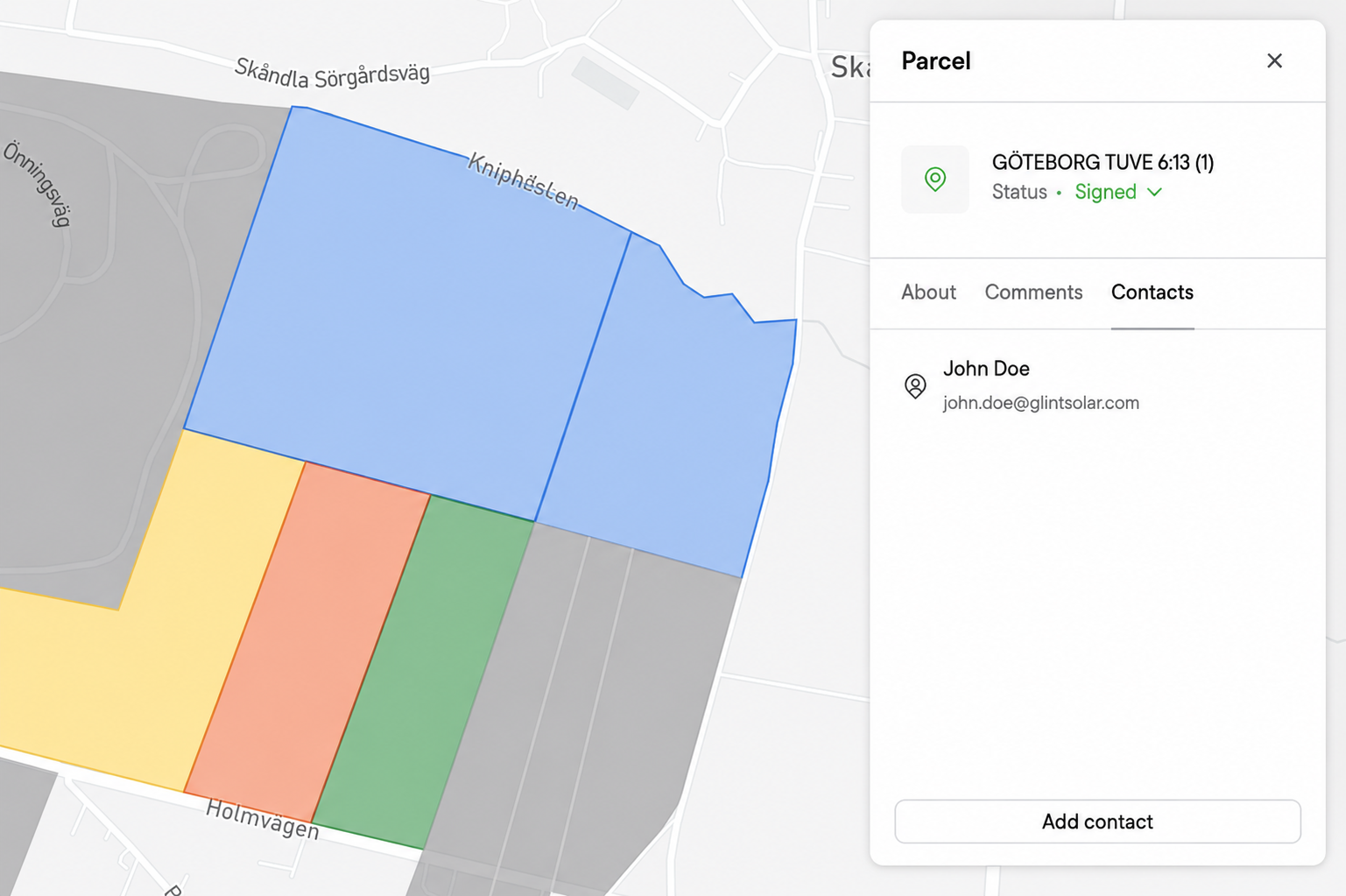
Parcels appear automatically as soon as you draw a project. Click any parcel to set its negotiation status, attach a contact, add a comment, or upload an agreement. Change a status to rejected and you can see the impact on your layout in seconds, not weeks. Contacts live at the organisation level, so the same landowner, grid operator, or municipality contact can be linked across multiple projects without duplication.
What you can do with Site control:
- Set negotiation status on any parcel and see colour-coded status across the map and parcel list
- Evaluate the impact of a rejected parcel on layout and yield, interactively
- Store landowners, grid contacts, and municipality contacts at the organisation level, typed by role
- Link the same contact across multiple projects and parcels without duplication
- Attach option agreements, grid offers, and planning documents to project comments, so the paper trail builds as you go
- Comment at the project, parcel, or contact level, with a project feed that surfaces every conversation in one place
- Sync Glint Solar with Salesforce, HubSpot, or another CRM through the API from day one
Who this is for
Site control is built for development teams managing portfolios at scale, where a single project can involve four or five landowners, a grid operator, and a municipality contact, and where the cost of losing context across handoffs is real. The same workflow applies whether the project is utility-scale solar, BESS, or hybrid.
It's most immediately valuable for teams that don't yet have a deeply-rooted project management system, or that are looking to consolidate workflow fragmented across QGIS, spreadsheets, shared drives, and inboxes. If you do have a CRM you don't intend to leave, the API is the route in. Glint Solar becomes the map and design layer of your existing stack, not a replacement for it.
One honest scope note. Parcels are currently project-scoped, so there's no automatic linking of the same parcel across separate projects yet. The feature is available in countries where Glint Solar has parcel data coverage. The platform doesn't replace your CRM. It connects your design tool to the systems where the rest of the work happens.
Ready to see it in action?
Book a demo and we'll show you how Site control fits into your workflow.