Published on April 27, 2026
That gap is reshaping how the German market works. Policymakers, BNetzA, and the four TSOs have introduced a new maturity procedure, replaced first-come-first-served queueing, tightened planning law for standalone BESS, made Flexible Connection Agreements the norm, and opened a fundamental review of the §118 EnWG grid fee exemption.
This article covers the seven biggest shifts and what they mean for site origination, design, and financing in 2026. The full 20-page guide goes further, with the complete TSO maturity phase timeline, the four-category scoring criteria, scenario modelling for grid fees, and the FCA stacking economics that drive project IRR.
Download the full guide here.
Co-developed with Philipp Schulz, renewable energy project developer at Recurrent Energy in Frankfurt. Philipp manages around 150 MWp of utility-scale solar PV and 300 MW of BESS development across Germany, leading projects from site acquisition through permitting to ready-to-build status.
1. Germany's BESS pipeline outgrew the grid connection system
Falling battery costs, rising price volatility, and the phase-out of coal and nuclear created a strong business case for utility-scale storage. Two-hour projects in Germany delivered annual revenues of around €259,000 per MW in 2025, with return expectations of 15 to 18 percent.
Developers responded fast. By the end of 2024, around 400 GW of battery storage had been submitted through grid connection applications. By 2025, that figure had jumped past 720 GW. Only 78 GW have received confirmed grid connection commitments, a number based on TSOs and the 17 largest DSOs covering roughly half of the national distribution grid.
For context: Germany's total installed electricity generation capacity is around 263 GW. Peak transmission demand is around 80 GW. Application volume sits multiple times above what the system can absorb, and that mismatch is what triggered the regulatory reforms now landing in 2026.
2. The "first come, first served" grid connection system stopped working
Until recently, grid connection in Germany ran on a first-come-first-served model under KraftNAV. Applications were processed in order of submission. That worked when volumes were low. It broke when developers started submitting requests for the same project at multiple grid nodes to improve their chances of securing capacity.
The result: a queue clogged with speculative or early-stage projects, immature applications blocking limited grid capacity, and grid operators forced to process huge volumes simultaneously. 50Hertz publicly described it as a "tsunami of storage connection requests."
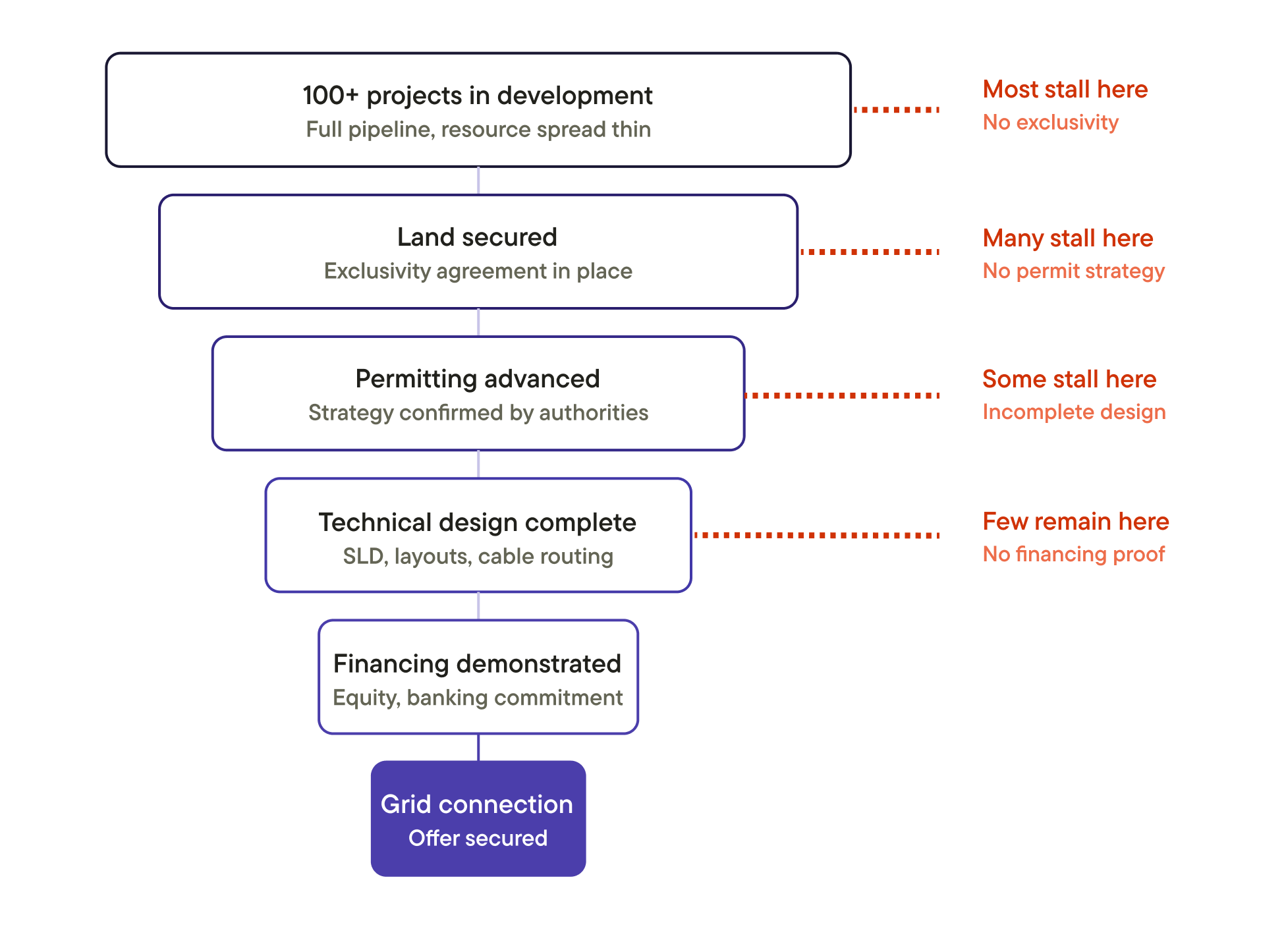
In a constrained grid, the queue-based approach could no longer allocate capacity efficiently. The replacement is a round-based maturity procedure that scores projects on quality, not order of arrival.
3. Planning law for standalone BESS has tightened, and is still moving
In November 2025, battery storage projects were granted privileged status under §35 BauGB, allowing certain projects to develop more easily in non-urbanized areas. That privilege was revised within weeks. Under updated rules from December 2025, standalone BESS now has to meet stricter criteria, designed to concentrate development near existing grid infrastructure.
The framework is still moving. A draft amendment to the BauGB circulated in March 2026 proposes replacing federal-level privileging under §35(1) with a new §35(1a), under which approval would depend on alignment with municipal land use plans. Critically, the overriding public interest status under §35(2), currently a key accelerator for renewables and storage approvals, would be abolished for these projects entirely.
There's also an unresolved interpretation of the 200-meter rule, where authorities and developers disagree on whether the entire project area must fall within the 200-meter radius of the substation, or only the project boundary needs to. The full guide unpacks the legal precedent and what it means for site selection in practice.
4. Flexible Connection Agreements are now the norm
Flexible Connection Agreements (FCAs) entered German law on 31 January 2025 and came into force in March 2025. By 2026, they're the default. They attach operating restrictions directly to the connection offer, and those restrictions cut into project economics.
There are four restriction types developers need to price in:
-
Import and export restrictions: caps on active power injection or withdrawal. Severity varies by region. Wind-heavy northern Germany, solar-heavy southern Bavaria, and demand-pressured NRW each face different stress points at different times. Caps can be static or dynamic, varying by season, time of day, or real-time grid conditions.
-
Ramp rate restrictions: limits on how quickly a battery can change its output. TSO guidance sits at 6–20 percent per minute. Some DSO proposals go as low as 1 percent per minute, which makes commercial operation very difficult without mitigation.
-
Ancillary service restrictions: caps on frequency response and ancillary market participation, typically 10–90 percent of installed capacity. The single harshest individual constraint for project economics.
- Uncompensated re-dispatch: grid operators can instruct BESS to curtail output for grid stability without compensation. Regularly underestimated in business plans, and most damaging in congested grid zones.
The business case still holds in many scenarios, but outcomes vary significantly. Stacked restrictions, particularly when combined with new grid fees, can compress project IRR by several percentage points. The full guide models the worst-case scenarios so financing teams can stress-test before applying.
5. Grid fee exemptions for storage are under review
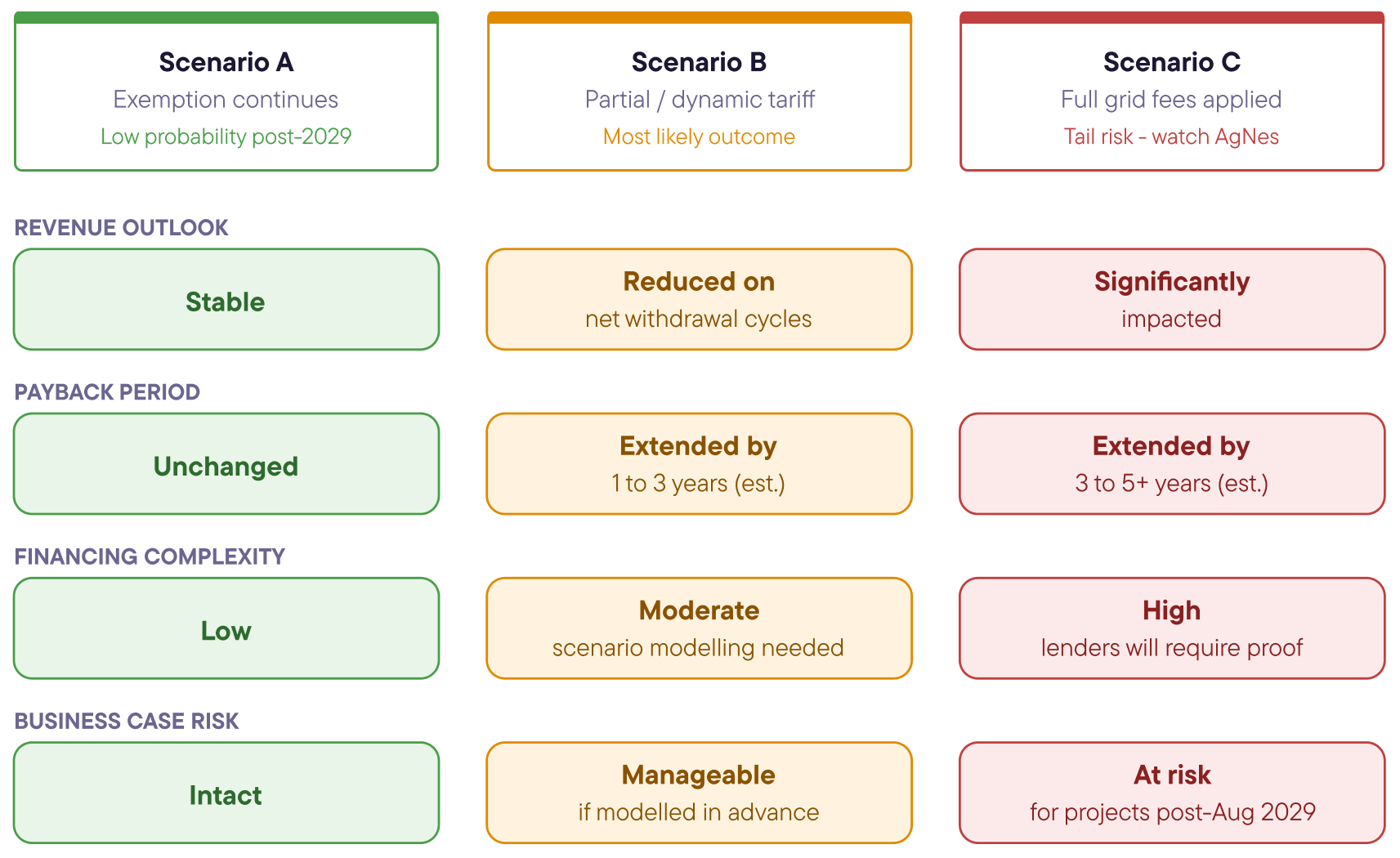
Storage systems commissioned before the end of August 2029 currently benefit from a 20-year exemption from grid fees under §118 Abs 6 EnWG. Many storage business cases assume that exemption will hold for the full duration. It may not.
In May 2025, BNetzA launched the AgNes process, and in January 2026 published its orientation paper signalling that the existing full exemption is incompatible with European law. Reform options under discussion include capacity-based grid charges, dynamic tariffs linked to grid congestion, and fees on net electricity withdrawal, with differentiated treatment envisaged for stand-alone, co-located, and multi-use storage assets.
A draft determination is expected by mid-2026, with new rules entering into force on 1 January 2029.
The most significant detail for developers is that BNetzA has indicated investor protection (Vertrauensschutz) can no longer be assumed. Already-operating projects could be exposed to grid fees retroactively. The guide breaks down three scenarios for the post-2029 tariff structure and what each does to revenue, payback period, financing complexity, and overall business case risk.
6. Project maturity is the new competitive advantage
Under the old system, two developers applying for the same substation connection were separated by timing. Whoever submitted first had the advantage. Under the new TSO maturity procedure, they're separated by project quality, scored against the same criteria at the same point in time.
Projects are evaluated across four equally weighted categories: land control, technical concept, applicant capability, and grid and system benefit. The first three carry 30 percent each. The fourth carries 10 percent.
In an oversubscribed connection round, the difference between a score of 14 and 11 out of 18 is the difference between receiving a binding grid connection offer and waiting for the next cycle.
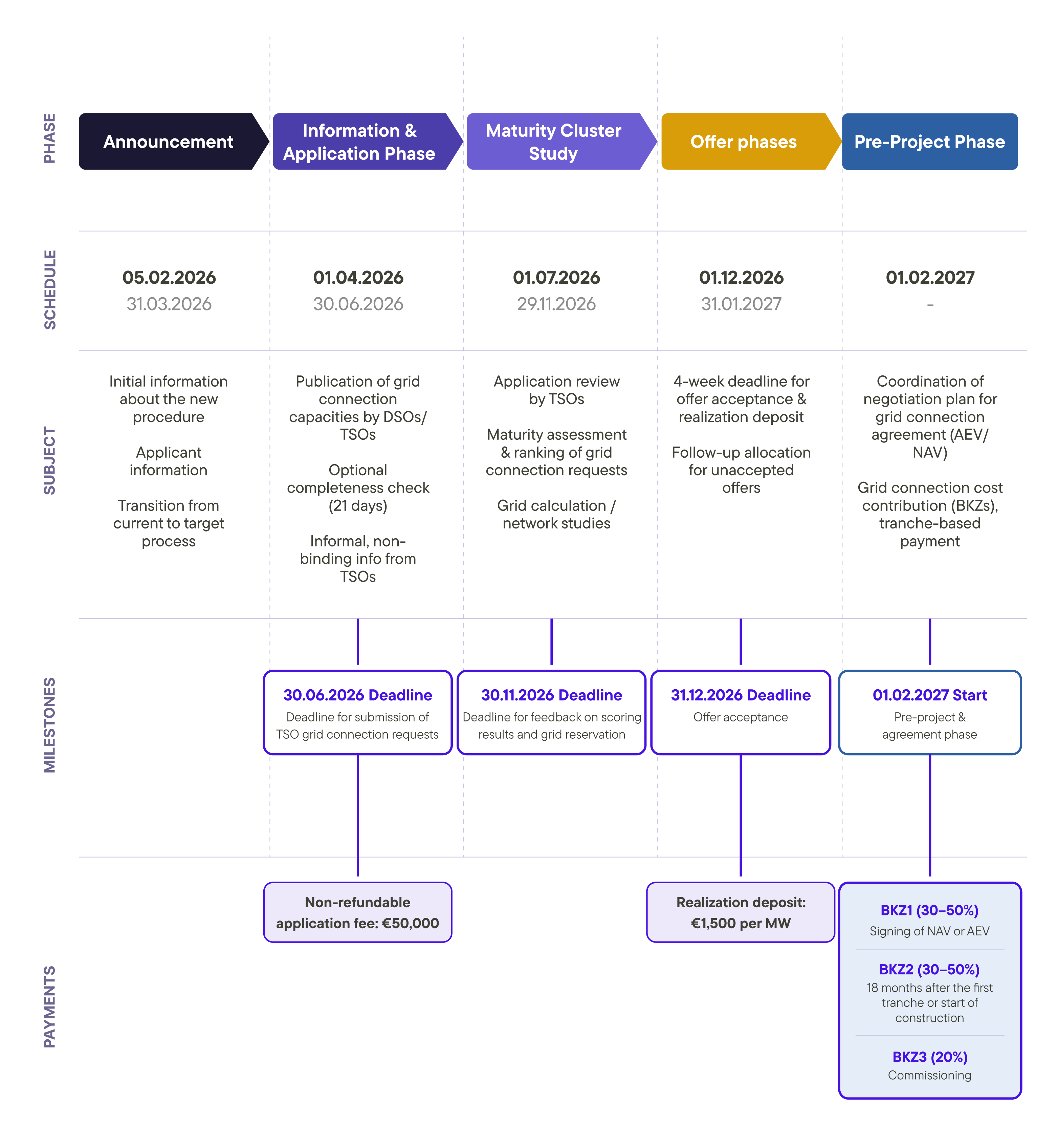
The procedure runs in five structured phases. The first application window opens on 1 April 2026 with a non-refundable application fee of €50,000. Each phase carries specific deadlines, payments, and BKZ tranches that determine when capacity is reserved and when grid connection contributions become payable. Missing a milestone in an earlier phase closes off options in the next.
7. Early site screening is now the highest-leverage step in BESS development
Germany added 842 MW of battery storage in 2025, nearly doubling the previous year, with 3.4 GW scheduled for 2026. The pool of viable substations isn't growing at the same rate.
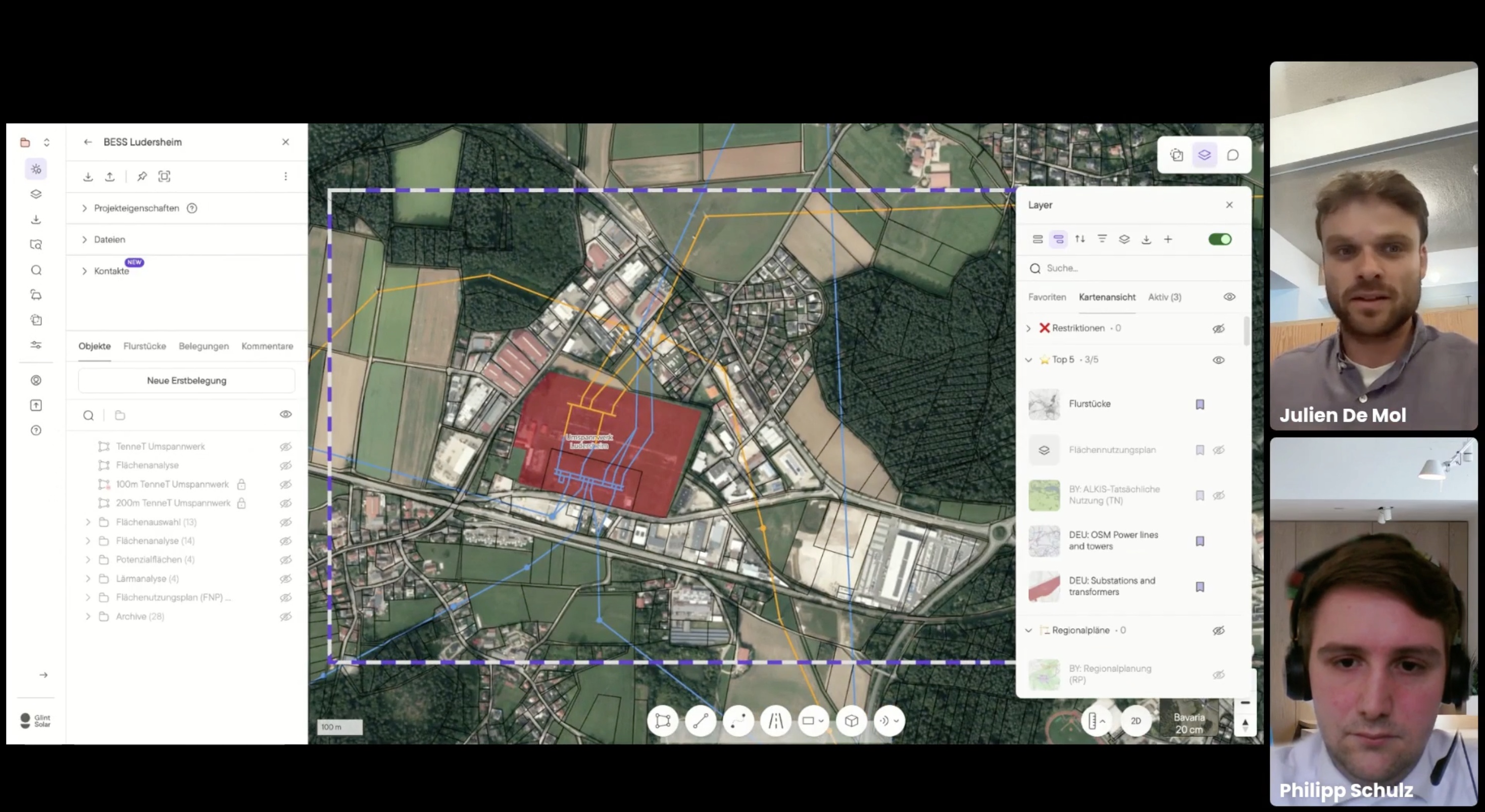
That changes the cost of slow screening. Sites that pass an initial check based on substation proximity regularly fail once full constraints are assessed: nature conservation zones, landscape protection areas, municipal area caps under the updated BauGB rules, cable routing limits, and grid capacity at the specific node. By the time those issues surface, weeks of development time have already gone into a project that was never viable.
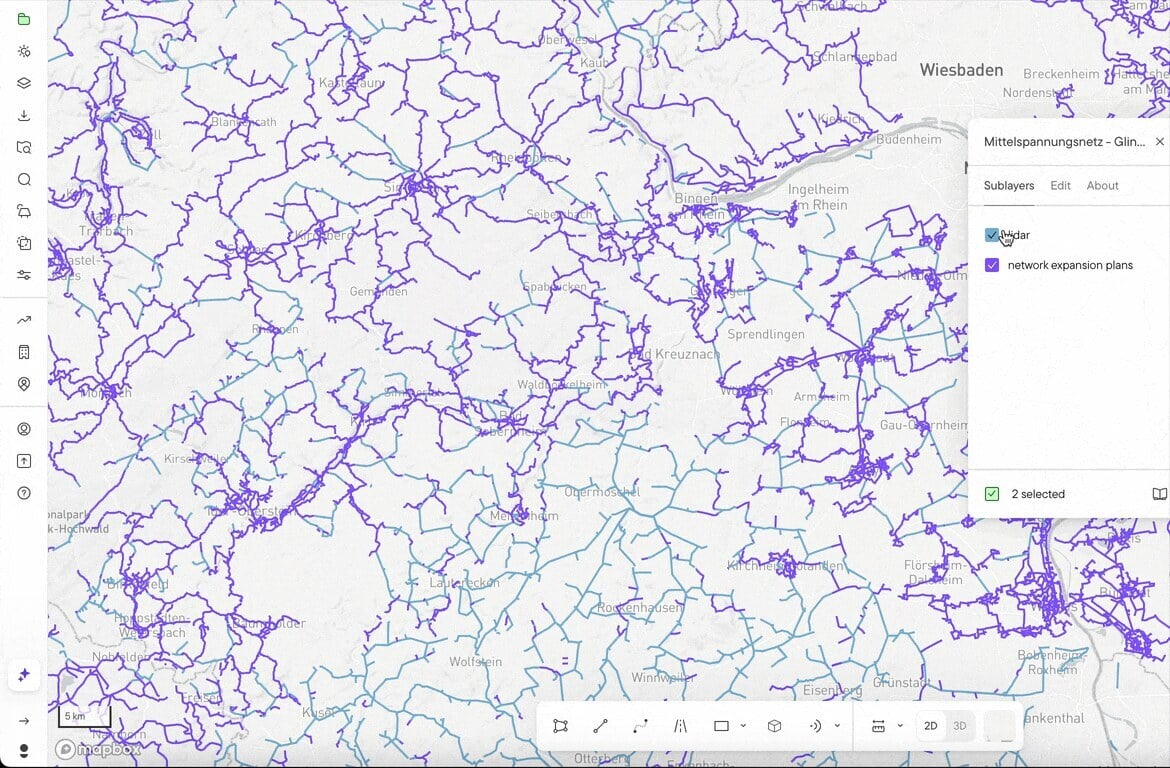
Round-based grid connection procedures punish slow decisions. The developers moving fastest in 2026 are the ones treating screening as a data problem, with grid infrastructure, planning constraints, and environmental layers brought into a single workflow before land is secured.
Final thoughts
Germany's battery storage market has changed structurally, and the changes are permanent. First-come-first-served is gone. Planning law has tightened. Grid fee exemptions are under review. Developers built around the old rules will need to rebuild around the new ones.
The opportunity is still substantial. Germany is the largest power market in Europe. The business case for large-scale storage is strong. The reforms, for all their complexity, are designed to accelerate the build-out of projects that are genuinely viable. What changes is the bar.
Securing grid capacity in 2026 takes earlier preparation, tighter pipelines, stronger documentation, and a clearer view of the financial risks ahead. The full guide covers what each of those requirements looks like in practice, including the maturity scoring criteria, the FCA stacking economics, the grid fee scenarios, and the developer workflow that holds up under round-based competition.
Download the full guide
7 Things You Need to Know About Germany's New Rules for Utility-Scale BESS — a 20-page market update covering the new TSO grid connection process, the maturity scoring framework, FCAs, planning law shifts, and the post-2029 grid fee outlook.
Download here.
German version found here.