Published on February 16, 2026
TL;DR
- A more structured solar market: PPE3 shifts France toward coordinated deployment, where projects need earlier feasibility validation, stronger grid relevance, and clearer alignment with territorial planning from the start.
- Quality over scale: The focus moves away from expanding huge pipelines toward progressing buildable projects, validating constraints earlier, and prioritizing realistic sites that can move through permitting and connection.
- Workflow changes for developers: Design, stakeholder communication, and portfolio visibility are moving earlier in the process, pushing teams toward more integrated, data-driven ways of managing early-stage development.
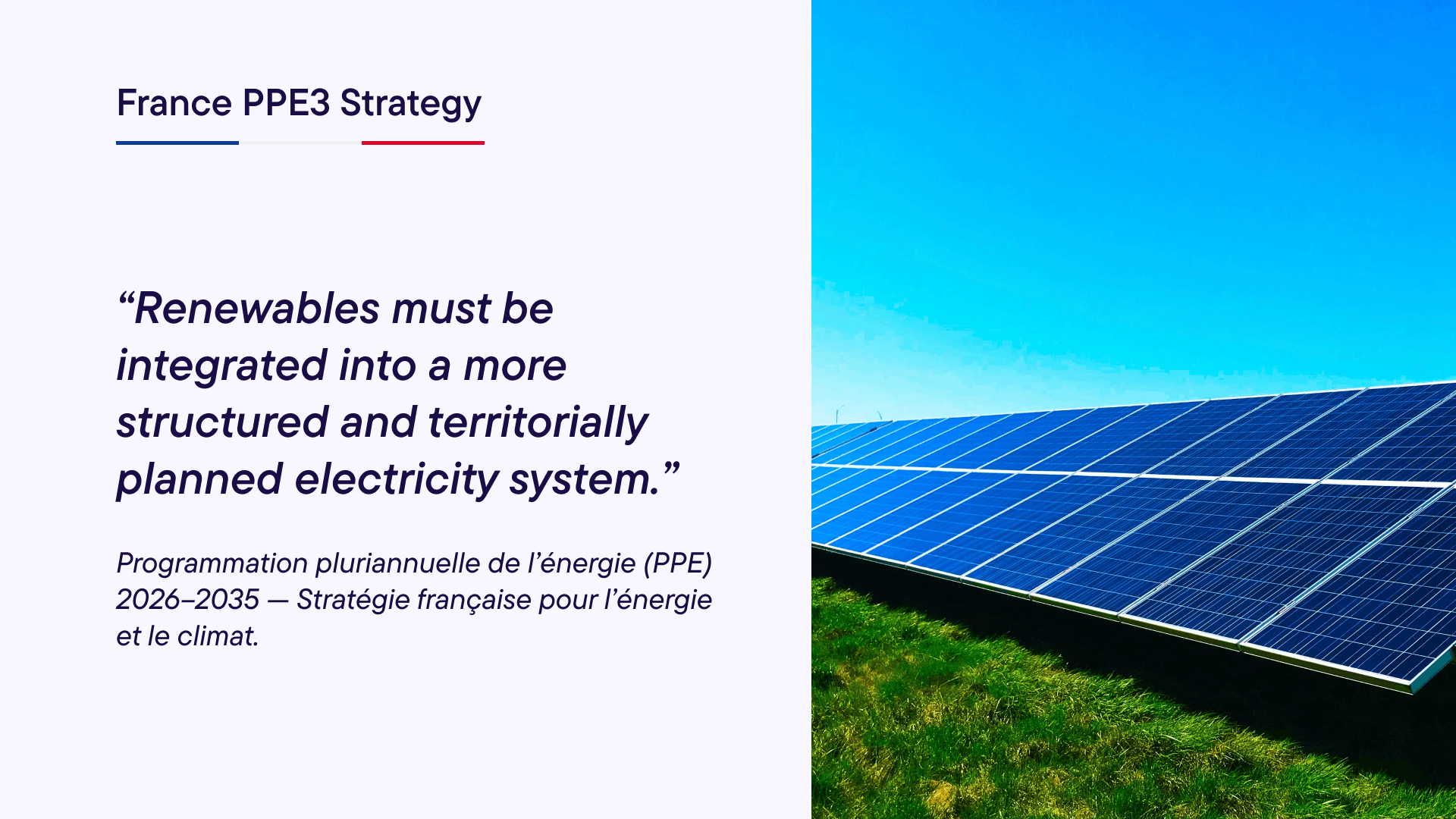
The new strategy outlines how nuclear and renewable energy, including large-scale solar, will expand together within a more structured electricity system. For teams working in utility-scale solar development in France, PPE3 signals a shift toward earlier feasibility validation, stronger territorial planning alignment, and more disciplined pipeline management. Solar remains central to the France solar market, but projects are increasingly expected to demonstrate grid relevance and realistic buildability from the start.
What PPE3 Means in Practice
- Earlier feasibility validation during solar project origination
- Stronger alignment with territorial planning frameworks
- Greater focus on pipeline quality over pipeline size
These themes reflect a broader evolution in the French energy strategy, where deployment speed is balanced with grid stability and long-term planning.
What PPE3 Signals for Solar Developers
Solar is moving into a more structured system
PPE3 positions solar alongside nuclear and other renewables within a stable, decarbonised electricity mix. The strategy emphasises coordinated deployment that supports network evolution and regional planning priorities rather than rapid, unstructured expansion.
That shifts key decisions earlier in the development process. Developers need clearer feasibility signals from the outset — not just land availability, but how a site integrates into the broader electricity system.
The target gap is smaller than it appears
France’s solar deployment trajectory relies heavily on progressing viable projects already in development or awaiting connection. This means the next phase of growth depends less on expanding pipelines and more on advancing buildable projects through permitting and grid integration.
For developers, this raises the importance of early validation, realistic assumptions, and faster iteration cycles during site qualification.
Territorial planning brings stakeholders closer to the start
PPE3 strengthens the role of territories in renewable deployment, encouraging local planning frameworks that guide where projects should emerge. As a result, stakeholder alignment is moving earlier into the workflow.
Projects increasingly need to communicate clearly with municipalities, landowners, and internal teams from the beginning — often through layouts, visuals, and structured site analysis.
The Real Shift: From Prospecting Land to Managing Pipelines
Historically, early-stage solar development often rewarded scale. Large pipelines helped teams navigate uncertainty around permitting, grid access, and policy direction.
A more structured market changes that dynamic.
Instead of expanding pipelines endlessly, many developers are refining existing portfolios — validating constraints earlier, iterating layouts faster, and prioritising sites with stronger fundamentals.
Three trends are becoming more visible:
- Feasibility moves upstream. Early analysis reduces late redesigns.
- Design becomes strategic. Visual clarity supports stakeholder alignment.
- Portfolio thinking grows. Teams manage risk across projects rather than focusing on individual sites.
These shifts don’t reduce solar development activity. They change how projects are prioritised and progressed within the pipeline.
Pipeline Quality Is Becoming the Main Differentiator
As electrification accelerates and fossil energy declines, renewable deployment is expected to become more efficient and more structured within the French energy system.
Stronger projects tend to stand out earlier because they demonstrate:
- realistic buildable areas
- constraint-aware site selection
- layouts that reflect real-world conditions
- visuals that help stakeholders understand impact
Repowering and optimisation may also become more relevant as developers revisit existing portfolios under clearer planning signals.
The bottleneck is shifting away from land discovery and toward early proof of viability.
What This Means for Development Workflows
Many teams are already adapting their workflows in response to these structural changes.
- Grid awareness is moving earlier into site selection.
- Design is starting sooner to support stakeholder conversations.
- Pipeline visibility is becoming essential as portfolios expand across regions.
Instead of relying on disconnected GIS tools, spreadsheets, and late-stage modelling, development workflows are becoming more integrated and iterative. The objective is not simply to build more projects, but to move the right projects forward with greater certainty.
A More Mature Phase for Solar Development And How Teams Are Adapting
France’s new energy strategy reflects a broader trend across European renewable markets. Development is becoming more coordinated, expectations around execution are rising, and teams are adopting workflows that allow faster validation and clearer collaboration.
Many developers are moving toward integrated platforms that combine site analysis, early design, and portfolio visibility. Platforms like Glint Solar are helping development teams adapt to this transition, enabling earlier feasibility evaluation, clearer project visualisation, and better pipeline oversight within a single workflow.
Rather than replacing existing expertise, these tools support a more data-driven approach to early-stage development, making it easier to respond to evolving planning frameworks and grid realities.

Moving Forward in a More Structured Market
PPE3 does not reduce the importance of solar in France’s energy transition. It raises expectations around how projects are planned, validated, and executed.
Developers who succeed in this environment will likely be those who validate assumptions earlier, collaborate more effectively across teams, and build pipelines around realistic opportunities rather than speculative growth.
In a more structured market, growth alone isn’t enough. Progress comes from pipelines built on real feasibility from day one.